
Article by: Jamesdc4
Applies to: All BMW models with the M62 engine.
There has been an ongoing debate about whether or not After Market Cold Air Intakes (CAIs) actually have any benefit or gains over the stock CAI. One school of thought has been that the factory CAI is extremely efficient and is difficult to improve on and that the only gain would be a more aggressive intake growl. In line with this thinking, someone discovered that you can delete the intake silencer and get the same results for the cost of a PVC cap and hose clamp. Substantially cheaper than an AM CAI.
Before doing this mod, please read this post:
Quote Originally Posted by techno550 . . .
“There seems to be LOTS of confusion/misunderstanding of how the intake systems on cars work. So instead of continuing to post things scattered in various threads, it’ll all go here (hopefully).
Like most things, bigger isn’t always better. Yet we see people try to put the biggest exhaust, largest intake, and widest tires on the car they can manage to fit. I blame a combination of marketing and stupidity for this, but perhaps it can be fixed.
This thread will focus on the basics of intake design BEFORE the throttle body. I think I’ve covered intake manifold design here on BF.C before. I’ll make some reference to the intake manifold design here as well, but I’ll leave it as something that BMW designed and nobody here will bother to change. If there are any of questions on its design, I’d be happy to start another thread for that as well.
So, onward. The intake manifold is designed to take advantage of resonances that occur naturally in the intake. These resonances are caused by the drawing of air into the cylinders. As the intake valves open/close, they create pressure waves. The mass of the air in the intake is accelerated toward the intake valves on the intake stroke, and when the intake valve closes, that mass + velocity has momentum. This creates a pressure wave that reflects off the closed valve and back out of the intake runner. The harnessing of this pressure wave, and tuning of its frequency, allows the engineers behind the intake manifold to take advantage of it. The reflection of that pressure wave off the back of the intake manifold, combined with other pressure waves from the other cylinders in harmony, will create a pressure wave towards the intake valve that will arrive just as it opens at certain RPMs. This lets the pressure wave assist with the filling of the cylinder, effectively cramming the air in, instead of just the piston trying to suck in air.
These intake resonance pulses don’t just stay confined to the intake though. With the throttle body open, they travel outward through the intake pipes until they find something else to reflect off of. Usually they work their way through the MAF and find themselves bouncing off of the air filter. From this, you can see that changing the length, diameter, or shape of the pipe between the TB and the air filter will change this frequency. That in itself shouldn’t be a problem, but usually these intake resonances can cause slight issues. Most common of which is giving bad readings from the MAF sensor. The MAF is counting on air flowing in only one direction over its sensor, and reversions of the air will greatly confuse its reading. It will be seeing more air “going into the engine” even though that air is actually going away from the engine. This means that small reversions, which should be subtracted from the “air into the engine” number are actually added. The ECU uses this value for fueling, and without knowing why, gets it wrong.
This is where resonance control comes into play. Enter the Helmholtz resonator. The Helmholtz resonator is there to attenuate the pulses that are outside of the intake plenum. A Helmholtz resonator is a cavity and a duct connected to the intake pipe. Its the triangular thing hanging off the air box on the E36’s. Its the gonzo nose looking thing on Subarus and the likes. etc. . . Its the “random empty box” hanging off the intake pipe that most people look at and go “what is this?”
Yes, it has a purpose.
The diameter required for the intake duct is also an easily calculated bit. Its generally accepted that you want the intake velocities to not exceed 180 ft/sec. I’d be willing to bet that the factory was pretty damn spot on with the sizing of that stuff. So I’d be willing to “randomly guess” that somewhere around 3″ is the right size for the intake pipes.
Next bit, notice how straight and short the tract is from the stock air box to the MAF? That’s intentional. As is the air horn (velocity stack) inside the air box. A bent piece of tube, even a mandrel bent one, will create turbulence. There is an exception to that though, and that’s if you can get the air to swirl through the pipe, completing at least one full revolution through the bend. If one full revolution is completed, then all the air in the pipe has traveled the same distance and there is nothing to create a funk with the flow.
Hopefully this will prompt someone to actually “design” a proper intake pipe, as well as cut down on the random un-engineering of the intake system.”
The following is the procedure for intake silencer removal on a 540i.
__________________________________________________
Tools and Supplies
- 6mm socket or common screw driver
- 10mm socket
- 1 inch PVC cap (not plug, cap only)
- Hose Clamp
Time to completion
- Approx. 15 minutes
Let’s begin:
Make sure your ignition is off and remove the top engine cover.
Then, disconnect the mass air flow (MAF) sensor.
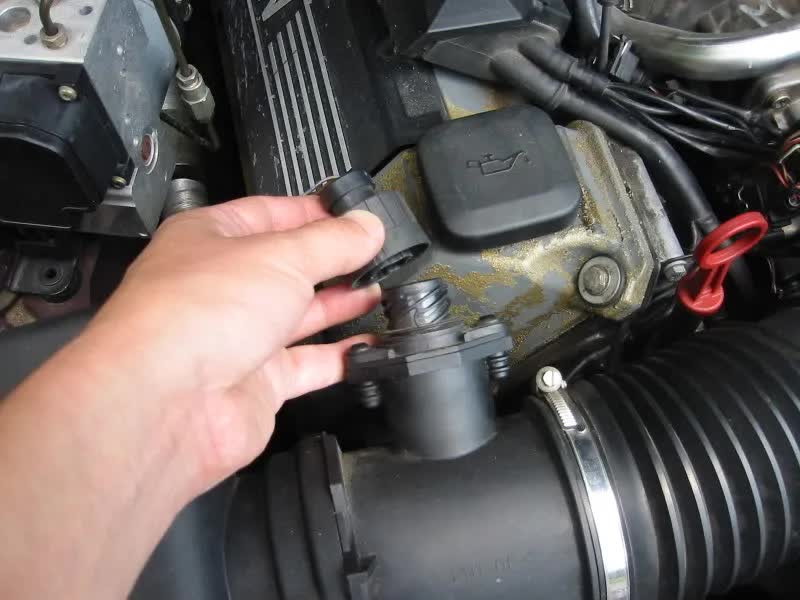
Disconnect the intake air temperature sensor.
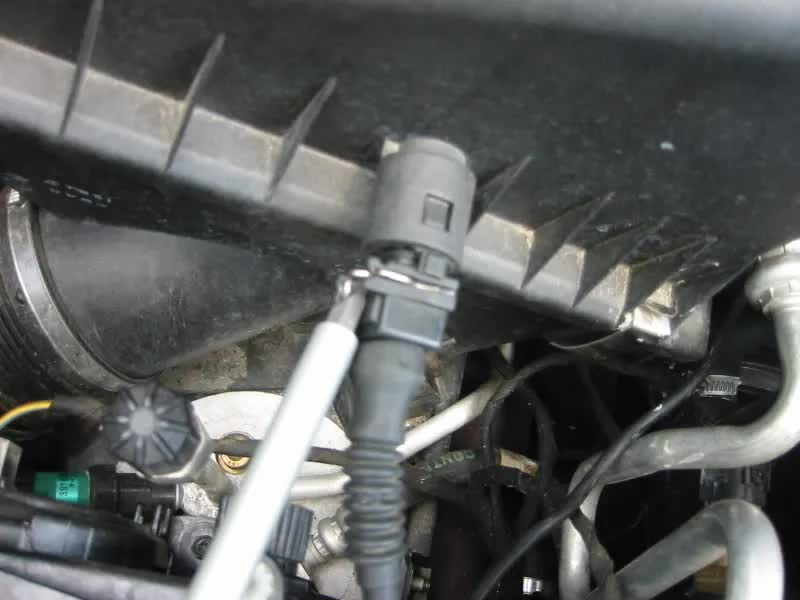
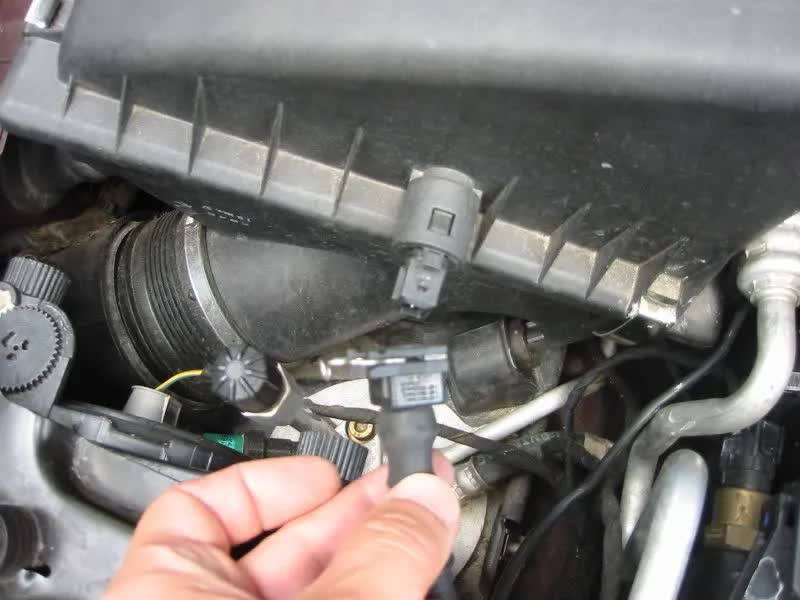
I later discovered that all you have to do is press down on the wire clip with your thumb and slide the harness off.
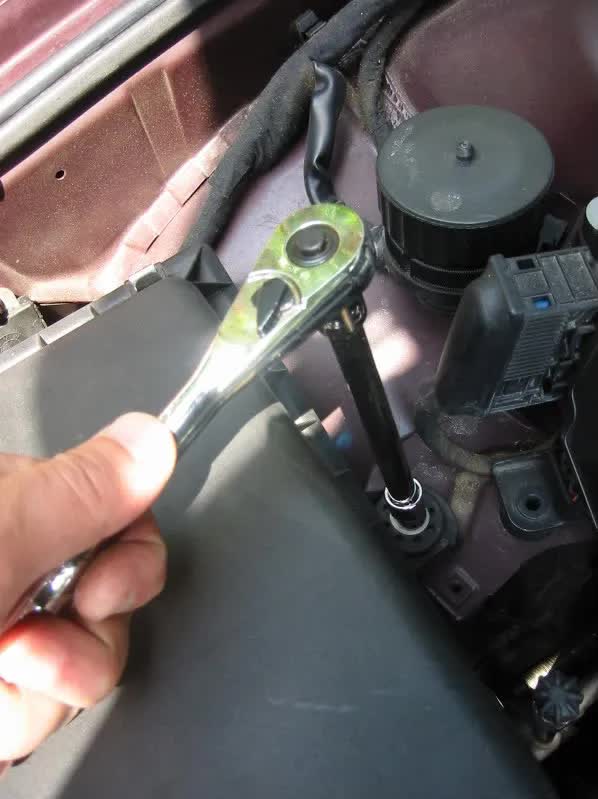
Remove the air filter housing mounting fastener (10mm socket).
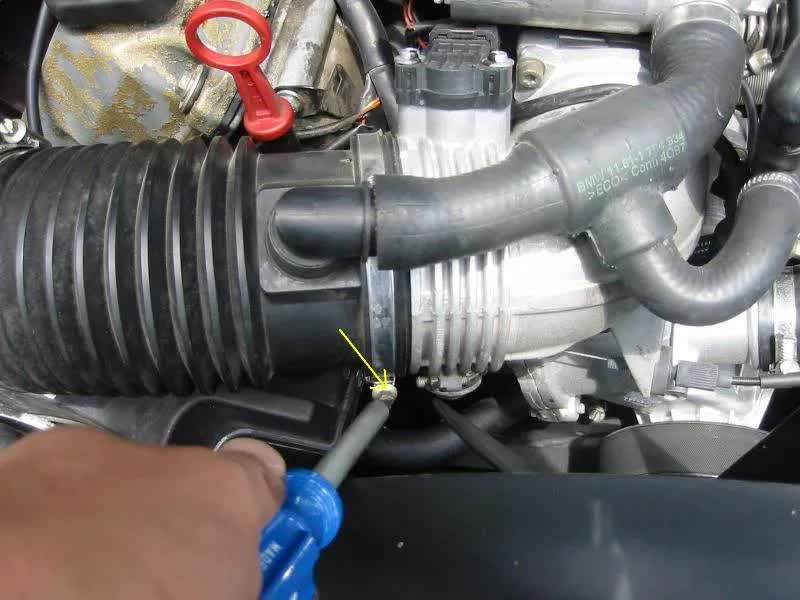
Loosen hose clamps (common screw driver or 6mm nut-driver).
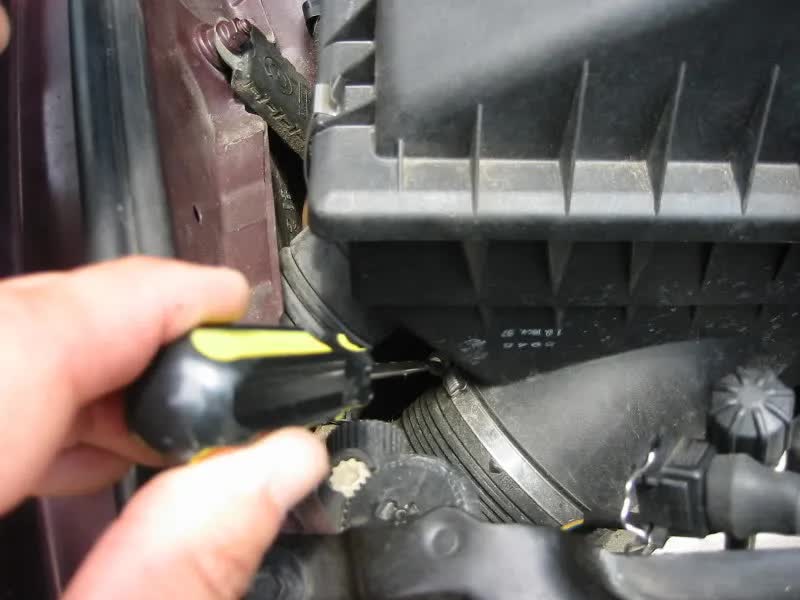
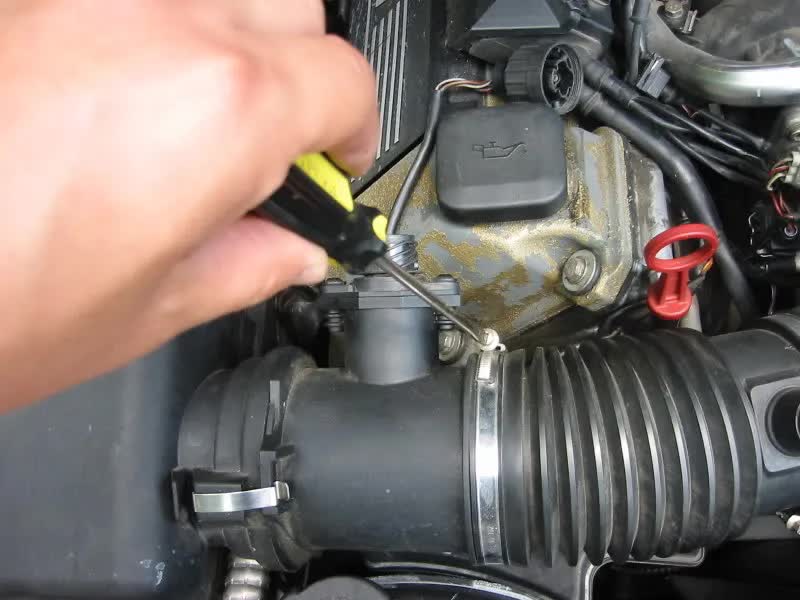
Remove the air filter housing and MAF. Although unnecessary, I found it was easier to work the housing out if I took the upper half of the housing off by disconnecting the clamps and exposing the lower portion of the housing containing the filter.
The red arrow points to the air silencer box.
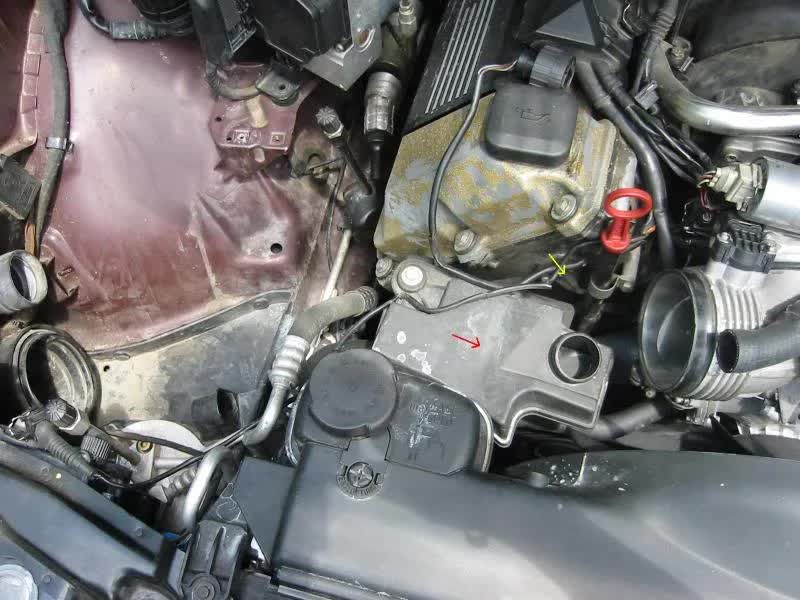
Remove the air silencer box (10mm nut-driver).
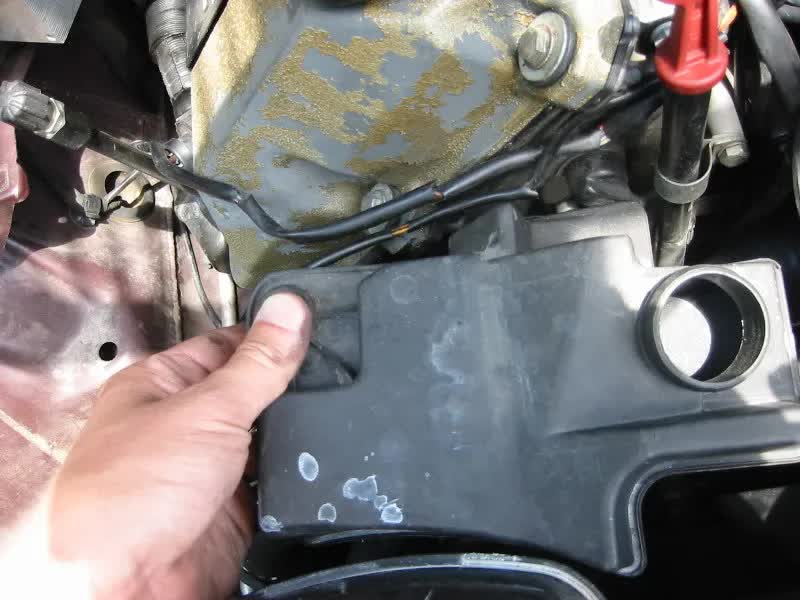
(The following is extracted from Kowached’s Camshaft Position Sensor replacement DIY here.)
Replace the air silencer box with a 1 inch PVC cap (not plug, cap only) and a hose clamp:
Leave the air silencer box out and reinstall everything in reverse order of tear down.